Interview with Nikhil Pandhi, Editor of “Love in the Time of Caste: A Dalit-feminist anthology of love stories”
Author Nikhil explores love as a radical anti-caste force, blending Dalit-feminist voices, translation, and lived realities in a powerful anthology.on Apr 07, 2026
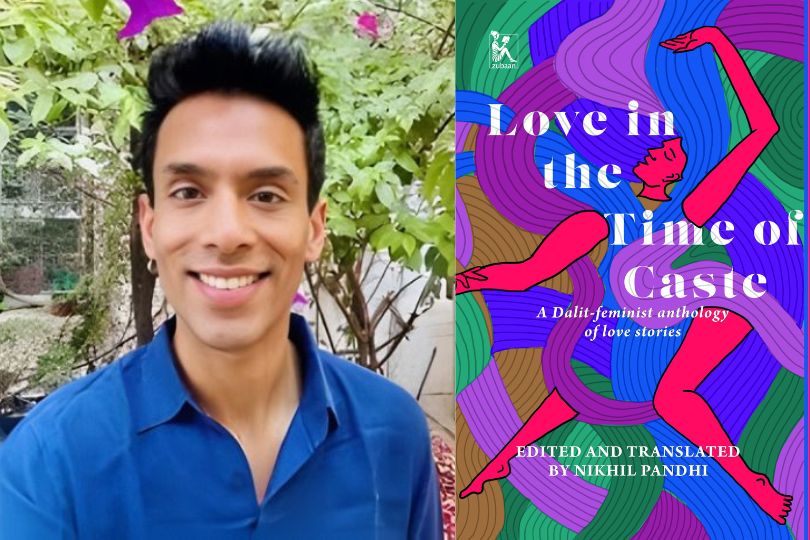
Frontlist: Love in the Time of Caste brings together stories where love exists alongside caste violence, patriarchy, and social control. What first inspired you to curate an anthology that places love at the centre of anti-caste storytelling?
Nikhil: There were several reasons why I chose to translate, curate, and centre this anti-caste anthology around ‘love’. For a start, these stories strike at the very foundation of modern India’s caste structure the control over women’s bodies, sexualities, desires, agencies, and aspirations whilst critically outlining love as a radical anti-caste force. In their own ways, they reclaim the capacious potential of love as desire, intimacy, care, conjugality, relationality, solidarity, and felt kinship to reframe cultural conventions around caste. At its core, casteism is about the mutation of interpersonal relations; the recursive degeneration of being and dwelling together. As these stories show, the antidote to that slow social poison — the force of imagining alternative ways of feeling and being together — also emerges from the same milieu. Love here becomes a verb-activity, a ‘doing’ that surges against the tyranny of untouchability a vital force that builds new everyday worlds. I was inspired to translate and curate these stories precisely because they showed us this while also nuancing the conversation around Dalit life as somehow being legible only through hurt, injury, and suffering.
Frontlist: As a socio-cultural anthropologist and literary translator, how did your academic training influence the way you selected, translated, and assembled these stories?
Nikhil: This anthology is intimately connected to my own scholarly research and practice as a queer-feminist social scientist. I started working on the book while conducting my doctoral fieldwork in northern India around the COVID-19 pandemic. The Hindi stories, which I assembled and eventually translated into English, came to me through my long-term association and work with the Dalit Lekhak Sangha (Dalit Writers Association). My research allowed me to form enduring relations with each of the writers featured in the anthology, learn about their creative processes, and exchange stories with them. Aside from this, a part of my research also tracked the everyday circulation of anti-caste thought and storytelling among Dalit doctors, healthcare workers, and low-income patients battling a range of illnesses, both as caregivers and care-receivers. As a medical anthropologist, what fascinated me was how such stories and storytelling critically illuminated new cultural models of healing and repair: through compassion, witnessing, community-based care, radical affiliation, and love. Seeing how these layered affective relations manifested in everyday life settings in contemporary India convinced me that this anthology must also foreground the cultural politics of love.
Frontlist: The anthology focuses on Dalit-feminist voices and lived experiences. Why was it important for you to frame this collection specifically through a Dalit-feminist lens rather than a broader social or political category?
Nikhil: I’m always intrigued when a critical frame like an anti-caste or queer/trans one is seen as ‘specific’ in contrast to something else that appears ‘broader.’ The problem is that this ostensibly ‘broader’ lens almost always becomes a proxy for dominant ways of seeing, which have systematically excluded anti-caste, Dalit-feminist, and other minoritarian voices, while ignoring the specificities of their suffering and erasing the wisdom they offer.
Dalit-feminist perspectives are crucial to reckon with precisely because of their historical proximity to sustained injustice. Based on this deep knowledge of pain, there is something particular about what Dalit-feminist visions of sociality can offer to alter normative, Brahmanical conceptions of life as these stories highlight. The strategic lessons offered in them have the potential to reframe Dalits as passionate subjects as beings deeply nourished by love, desire, and intimacy, in a world that sees Dalit life only through the skewed lens of suffering and pain while also challenging Brahmanical scripts of marriage, kinship, conjugality, pleasure, and power. Dalit-feminists teach us not only to keep compassion alive, but also reaffirm the need to acknowledge the lived experiences of those whom dominant histories and normative politics will never archive.
Frontlist: Many of the characters in the book struggle with the tension between political resistance and intimate relationships. Did you notice any recurring emotional or social patterns across these stories while working on them?
Nikhil: There are several intersecting themes that make these short stories novel and deeply compelling as contemporary portraits of anti-caste life and sociality. Among these, love in all its embodied shades: living with it; dying with (or because of) it; abiding with it whilst garnering an altered political consciousness; discovering new ways of relating to each other across difference; or simply dreaming and fantasizing about new modes of freedom emerges as a central thread across the stories. Love here indexes a range of everyday possibilities of practicing and feeling liberation.
As one might imagine, this is not an easy kind of love; it isn’t naïve, apolitical, or bereft of organic material consequences. Its purpose, if any, is to highlight that in a caste-ridden society like ours, love can be both tyrannical and transformative; it can create distinctive constraints, contours of violence, and a carapace of injuries, while equally offering radical possibilities in the face of abjection.
Frontlist: Translation is never just about language; it’s also about culture, power, and context. What were some of the biggest challenges you faced while translating these deeply rooted, culturally specific narratives into English?
Nikhil: Translation is a multi-dimensional and deeply power-laden undertaking. Just like storytelling. We live in a world not only of unequal stories, but also of unequal translations. If the stories of communities (especially Dalits, queers, and other intersectional minorities) are deeply undervalued and erased so too are their translations.
Quite apart from the source language (Hindi, in this case), English itself presents a very unequal terrain of signification for a community’s narratives and chronicles especially Dalit life. The English(es) we speak, and especially that which is promulgated as ‘proper’ and publishable, is deeply scarred by coloniality and Brahmanism. So, one of the biggest challenges I encountered in this fragmented postcolonial milieu of the metropolitan anglophone was to find a home for these stories.
English publishing, I learned, despite its best intentions, remains quite caste-blind and structurally naïve. It also doesn’t recognize translation as a form of queer labor. A feminist publisher like Zubaan saw potential in these stories, while others whom I was in dialogue with initially did not or, sadly, could not, owing to their own internalized Brahmanism. All this is to say that the challenge for queer anti-caste translators like myself operates at several levels, and English itself is not free from caste and capital’s postcolonial baggage.
Frontlist: Several stories portray love not as escape, but as a site of conflict, assertion, and even rebellion. In your view, how can love become a radical anti-caste force in contemporary India?
Nikhil: Alongside assertion, rebellion, and resistance, love also teaches compassion, cohabitation, and the possibility of dwelling with empathy, especially through a sharpened and shared humanistic sensibility. Recognizing this wider political horizon of love is, to my mind, the first step toward transforming it into an anti-caste force. In a caste society, love is never just a private experience; it becomes politicized the moment it unsettles inherited boundaries of community, family, and social order. The persistence of inter-caste relationships in our country despite mounting cases of so-called ‘honour’ killings, suicides, and abandonment tells us that love can become a way of embodying social justice without making its stakes abstract. It brings the struggle against caste into everyday life into questions of kinship, belonging, and shared futures.
In that sense, love becomes radical not only because it transgresses caste, but because it imagines an entire gamut of social relations grounded in equality rather than hierarchy. Through this quiet insistence, love unsettles casteism at its most intimate foundations where it is most stubbornly reproduced.
Frontlist: As a queer feminist scholar and anti-caste translator, how do questions of gender, sexuality, and caste intersect in this anthology? Were there stories that especially challenged or reshaped your own understanding?
Nikhil: Each story in this collection quietly and unhesitatingly pushes the envelope around how caste, class, gender, and sexuality intersect in the contemporary world around us. What fascinated me as I assembled, edited, and translated these stories were the ways in which they allow us to examine these complexities in inter-caste and intra-caste settings; and specifically in kinship contexts that include marital and non-marital conjugality, sibling relations, family dynamics, and romance across a range of sites including the metropolitan workplace, home, city, village, university, clinic, and even everyday spaces of leisure and consumption.
In stories like ‘Ambar’, ‘Haze’, and ‘Caves’, the protagonist is a middle-class Dalit working woman a subjectivity we strangely know very little about, but must grapple with. In stories like ‘Mhow’ and ‘Aching Nerve’, the protagonists struggle with complex emotions around institutional casteism in universities and colleges, all the while dealing with questions of desire and intimacy. In ‘Blue Mountain, Red Sun’ and ‘The Chronicle of Kali’, the lens turns reflexively to examine casteism amongst the ‘lower castes.’ Equally, in stories like ‘Raga’s Beloved Ragini’ and ‘Trauma’, questions about love and desire subtly emerge interwoven with searing realities of mental health and psychic violence in striking ways.
I chose to curate and translate these stories because together they expose and explode ingrained cultural normativities around caste and desire across a range of settings and social worlds.
Frontlist: What do you hope readers, especially those who may be unfamiliar with Dalit literature or anti-caste thought, will carry with them after reading Love in the Time of Caste?
Nikhil: I envision diverse readers taking away myriad things from this collection. For those yet unfamiliar with caste and its machinations, I hope these stories convey how subtly and significantly casteism poisons personal and interpersonal relations how caste (still) abides in everyday life, and how its tentacles of tyranny encompass the personal, the social, and everything in between. I hope these stories help readers critically question their biases, forge new understandings of caste in relation to global modes of discrimination, and ultimately develop a caste-sharpened consciousness. Equally, for readers acquainted with anti-caste politics, or steeped in other liberal traditions of resistance, I hope the stories inspire everyday imaginations of even more radical futures than those currently being imagined highlighting the fact that there are plural ways of annihilating caste, and that inter-caste marriage, desire, intimacy, and kinship are all part of the critical labour involved in changing sedimented social and cultural orientations towards gender, sexuality, and conviviality.
At any rate, I hope that the Dalit-feminist modes of thought and action archived in these stories offer readers a fresh vantage point from which to understand contemporary Indian society and its horizons.
Post a comment
0 comments
Trending Posts
.jpg)
.jpg)

.jpg)
.jpg)
.jpg)
Recent Post
.jpg)
.jpg)
.jpg)
.jpg)



Related Post




© 2026 - Frontlist - News and Updates of Publishing Industry, Book Reviews, Education News, Author Interviews, and Videos.. All Rights Reserved.
Sorry! No comment found for this post.